

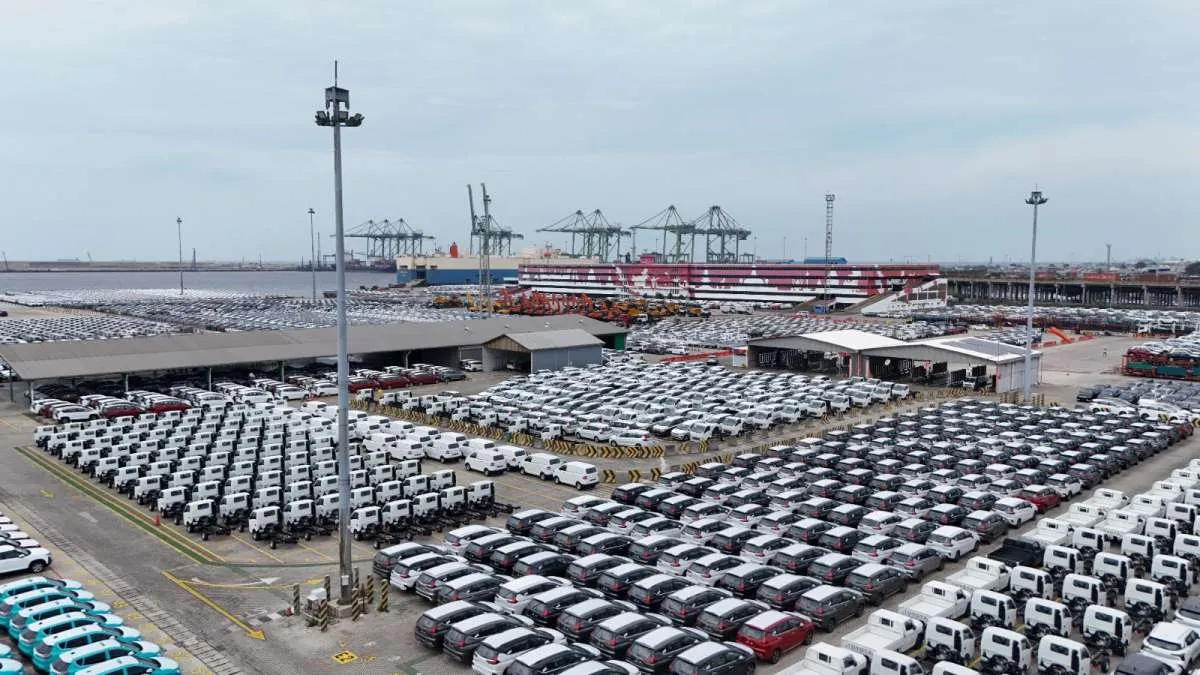
The port of PT Indonesia Kendaraan Terminal Tbk (IPCC) in Tanjung Priok, North Jakarta. Revenue and profit of PT Indonesia Kendaraan Terminal Tbk (IPCC) rose in tandem, despite a declining trend in domestic car sales. (Photo: KONTAN)
KONTAN – Revenue and profit at PT Indonesia Kendaraan Terminal Tbk (IPCC) have increased, despite a downturn in domestic car sales. The company, part of the Pelindo Group, has been focusing on optimizing the surge in import and export handling volumes. IPCC’s revenue rose 12.70% year on year (yoy) — from Rp 585.82 billion to Rp 660.24 billion — by the third quarter of 2025. Meanwhile, its profit grew 28.55%, from Rp 148.02 billion to Rp 190.29 billion.
According to IPCC President Director Sugeng Mulyadi, revenue is composed of 78% from international services and 22% from domestic operations. By cargo type, completely built-up (CBU) cars remain the main contributor, accounting for 72.77% of total revenue.
The terminal also handles heavy equipment (10.35%), trucks and buses (8.78%), and other cargo (4.90%). International CBU handling (exports and imports combined) rose about 21% yoy. Export handling increased by roughly 10%, while import handling surged around 80%. In contrast, domestic CBU handling fell about 18%, although activity at satellite terminals (outside Jakarta) grew 2.8%.
The strong growth in international cargo, combined with value creation strategies and digitalization and automation efforts, has been a key driver of IPCC’s performance. “Going forward, we’ll continue improving efficiency so that our cost structure and performance remain competitive,” Sugeng said during a public presentation on 29 October 2025.
IPCC maintains a dominant market share in vehicle terminal operations. In the export cargo segment, IPCC controls 74.40% of the market, while in import cargo it commands 84.63% as of the third quarter of 2025.
This means IPCC stands to benefit whenever there’s an increase in CBU car import and export volumes. Although the domestic market has softened, Sugeng believes the export outlook remains promising. Export destinations include South America (particularly Mexico), the Middle East, Southeast Asia, Australia, and Europe, supported by new trade agreements. “There’s still plenty of room for exporting Indonesia-made vehicles,” Sugeng said.
On the import side, IPCC has gained from a surge in battery electric vehicle (EV) imports.The jump in CBU EV imports is driven by government incentives for automakers investing in local production. These incentives will expire at the end of this year, prompting EV manufacturers — particularly from China such as BYD — to accelerate shipments. As of September 2025, IPCC handled 57,035 EV units.
BYD was the largest contributor with 37,410 units, followed by VinFast (16,161), Geely (1,801), Aion (1,026), and VW (293). In total, IPCC estimates the EV cargo segment could exceed 70,000 units this year. “To make the most of the incentive, manufacturers will ramp up imports through year-end,” Sugeng said.
“The government won’t extend the incentive, so they’ll maximize their quotas while they can.
Sugeng said he is not concerned about the expiration of import incentives next year, since automakers will be required to start local production. These locally built EVs will not only serve the domestic market but also be exported, creating new opportunities for IPCC’s logistics business.
“The government is encouraging exports as part of a strategy to make Indonesia a regional automotive hub,” he said. “So the next challenge is preparing export capacity to meet future demand.”
To sustain its growth momentum, IPCC has prepared a 2025–2029 roadmap, including systematization and digitalization of business processes, expansion of RoRo terminals in new areas, and capacity and facility upgrades. Through these service improvements, IPCC also plans to boost commercialization—especially at its satellite terminals—and is currently reviewing tariff adjustments.
“Integrated services require transformation and collaboration across the ecosystem,” Sugeng said. “This ensures customers receive better value, even with some price adjustments.”
Looking ahead, Sugeng remains confident that IPCC will maintain double-digit growth this year. “We’re optimistic about closing 2025 with over 20% growth, supported by strong fundamentals and good corporate governance,” he said. (*)