


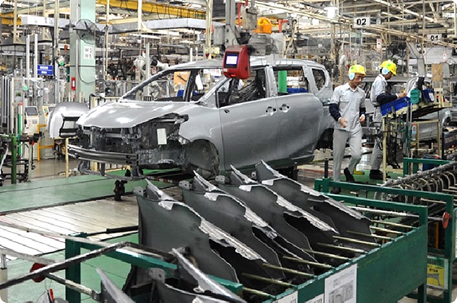
The development of the Indonesian automotive industry is influenced by several factors. Of these, government policies and the national and global economic situation have the most direct influence. Furthermore, the industry’s development is also influenced by advances in vehicle technology, demands for environmental friendliness, safety, and information technology (IT).
The automotive industry is currently viewed as a strategic sector for the Indonesian economy. It contributes approximately 10.47% of the national Gross Domestic Product (GDP) to economic growth. The automotive industry is currently among 11 non-oil and gas industry sectors prioritized for development by the government and is considered a barometer of national economic growth.
According to the Indonesian Ministry of Industry, as of 2021, there were 22 companies producing four or more wheels in the Indonesian automotive industry, with a total annual production capacity of 2.35 million units. According to the Coordinating Ministry for Economic Affairs, this sector generated Rp 700 trillion in investment, both domestic and foreign, primarily from Japan, South Korea, and China.
The automotive industry employs 1.5 million people directly and indirectly. This workforce is distributed across various sectors, from assembly and first-, second-, and third-tier component industries to sales, after-sales service, and spare parts. Indonesia’s automotive products meet not only domestic transportation needs but also export needs. Indonesian vehicles reach export markets in 81 countries, including Saudi Arabia, Vietnam, Mexico, the Philippines, Japan, and Australia.
The motor vehicle industry’s contribution to the national economy also comes from several tax revenue sources. These include Value Added Tax (VAT), Luxury Goods Sales Tax (PPnBM), Motor Vehicle Transfer Fee (BBNKB), and Motor Vehicle Tax (PKB).
The motorized vehicle population in Indonesia grew steadily after 1970, driven by government policies to encourage the growth of the domestic motor vehicle manufacturing industry. The government issued a policy shifting imports of Completely Built Up (CBU) vehicles to imports of Completely Knocked Down (CKD) vehicles, which would then be assembled in Indonesian assembly plants.
Although several brands have opened factories and mass-produced in Indonesia, a number of brands still import motor vehicles into Indonesia. Some brands that enliven the motor vehicle industry and market in Indonesia, both through the assembly industry and CBU imports, include Audi, BMW, Chevrolet, Chery, Chrysler, Daewoo, Daihatsu, Datsun, DFSK, FAW, Ford, Hino, Holden, Honda, Hyundai, Isuzu, KIA, Land Rover, Lexus, Mazda, Mercedes-Benz, Mitsubishi, MINI, Nissan, Peugeot, Porsche, Renault, Scania, Suzuki, Subaru, Tata, Toyota, UD Trucks, Volkswagen (VW), and Wuling.
From the brief overview above, it appears that the national motor vehicle industry has grown and evolved over time, adapting to the demands of the times. Broadly speaking, the dynamics of the motor vehicle industry, from its inception to the present, are as follows: